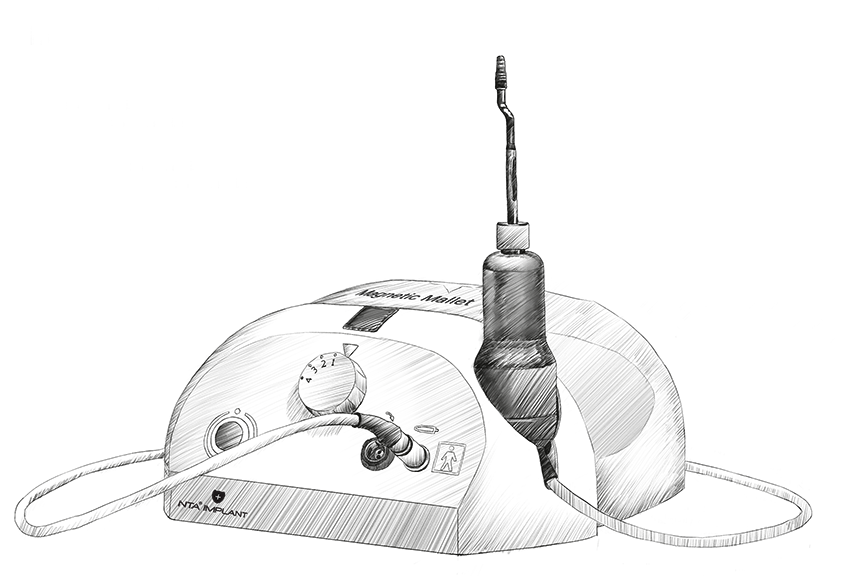
Magnetic-dynamic force for osteotomy and bone condensation
The Magnetic Mallet delivers a magnetic-dynamic impulse with a stated 5000 G acceleration. An electronic controller lets the clinician set force by turning a dial. Compared with manual instruments, the calibrated strike delivers higher force to the selected site in a shorter interval — stated as 30% higher force than a conventional hand instrument. Use follows the device IFU.
One device is specified for several osteotomy and restorative procedures when used per IFU:
Osseodensification (condensation): Condenses bone to form the osteotomy without rotary bone removal.
Sinus lift: Magnetic-dynamic control for crestal sinus elevation per IFU.
Atraumatic extraction: Extraction intended to limit trauma to adjacent bone and soft tissue.
Implant placement: Kinetic impulse for fixture seating at the planned angulation. Primary stability depends on bone quality and the IFU protocol.
Guided surgery: Compatible with digital surgical guides when the guide and IFU allow.
Crown removal: Dedicated traction accessory applies controlled force to remove a crown while limiting damage to the restoration.
DEVICE CHARACTERISTICS
100% consistent: Moves, shapes, and condenses bone. The mechanism is non-rotary; bone removal and soft-tissue injury are not the intended mode of action. Follow the IFU.
100% fast: Magnetic-dynamic impulse delivers higher energy than manual hand instruments, which can shorten chair time.
100% precise: Kinetic energy is directed to the treatment site rather than distributed through the craniofacial mass.
Accessory: Crown remover
The Magnetic Mallet crown-remover accessory produces longitudinal traction. Controlled force is applied to remove a crown while limiting fracture or displacement of the restoration. Use per IFU.
Laboratory data: University of Milan (MIUR) tests
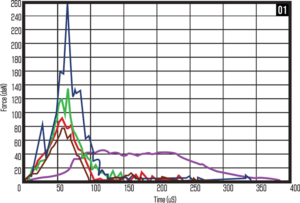
Tests at CNR – Centro Nazionale di Ricerca, University of Milan (MIUR), compared Magnetic Mallet impulses with manual surgical mallets:
Graphical analysis attributed an impulse of 40 dekaNewton (daN) applied in microseconds, to the Magnetic Mallet.
The recorded impulse supports rapid, consistent, minimally invasive procedures when the IFU is followed.
The device does not cut or drill; it is specified for bone condensation. Thermal rise from rotary cutting is not the operating mode. Follow the IFU.
01: Applied-force comparison (daN/μs): Magnetic Mallet levels 1, 2, 3, 4 vs manual surgical mallet. Tests at CNR – Centro Nazionale di Ricerca, University of Milan – MIUR.
BROCHURE AND DOCUMENTS
MAGNETIC MALLET BROCHURE
Contact us for further information or to view the Magnetic Mallet brochure.